

Introduction
Aligned to PMBOK® (8th Edition) principles and PMIEF Project Management Skills for Life® (2025)
This guide supports STEM Racing teams in applying modern project management practices throughout the season. It is aligned to PMBOK® (8th Edition) principles and integrates the language, tools, and learning approach from PMIEF’s Project Management Skills for Life® (2025). Use it alongside the Project Management Scorecard and build evidence as you plan, deliver, learn, and improve.
How this guide helps you
We know that teams that leverage strong project management processes and tools perform better overall. Across all sections, you will see PMBOK® (8th Edition) themes woven into the practical steps: focus on value, engage stakeholders, tailor your approach, build quality in, manage risk and opportunities, enable change, and learn continuously. The goal is not to create more paperwork, it’s to make decisions visible and measurable.
How to use this guide
Use this guide from the start of the season and revisit it as your project evolves:
- Tailor: choose the level of detail that fits your team, timeline, and complexity.
- Make decisions visible: record why you chose an option (especially when time/cost/quality trade-offs exist).
- Quantify where you can: risk scores, KPIs, and planned vs. actual tracking strengthen your evidence.
- Review on a cadence: short check-ins + regular status reports help you adapt early, not late.
- Keep artifacts current: charter/scope, WBS & schedule, budget, risk register, stakeholder plan, and change log should evolve with the project.
PMBOK® (8th Edition) principles
- Focus on value (what matters most to sponsors, your team and judges)
- Engage stakeholders (communicate in ways that work for different people)
- Tailor your approach (right-sized documentation and meetings)
- Build quality in (define acceptance criteria and check early/often)
- Manage risk and opportunities (prioritise, act, and re-check)
- Enable change (use a simple change/issue log so changes don’t derail the plan)
- Learn and improve (use lessons learned to show measurable improvement over time)
Direct alignment to the Project Management Scorecard
Each scorecard category is supported in the matching section of this guide. In higher score bands, assessors are looking for evidence of: measurable planning (WBS, dependencies, critical path), disciplined tracking (planned vs. actual, KPIs, forecasting), structured decisions (cost/benefit rationale), stronger stakeholder engagement, quantitative risk scoring (plus opportunities), and controlled change (documented requests and approvals).
STEM Racing & the Project Management Educational Foundation
In 2020, STEM Racing partnered with the Project Management Institute Educational Foundation to integrate project management into the competition. This guide supports teams in leveraging these skills for their STEM Racing car and entry, with applications across various industries.
Andrew Denford, Founder and Chairman STEM Racing, says of the association with PMIEF:
“We’re delighted to welcome PMIEF as a partner of STEM Racing and look forward to a long and successful relationship. Project management is fundamental in our Challenge, as the students have limited time and resources for taking their STEM Racing entry from concept to reality and I’m sure that PMIEF will be able to assist our students with this process. The scope of the partnership allows us to extend the learning and training to STEM Racing staff and our In-Country Co-ordinators (ICCs) who deliver the programme internationally, and I am sure there will be enormous benefit to both individuals and STEM Racing to have this opportunity.”
The PMIEF Executive Directorship said of the relationship:
“Our partnership with STEM Racing helps bring project management to life for youth. By embedding real project management practices into this globally recognized challenge, students don’t just learn concepts, they apply them in meaningful, hands on ways. We believe this experiential approach builds confidence, decision making skills, and a strong foundation that students can carry into their education, careers, and communities."
About PMIEF
PMI Educational Foundation (PMIEF) is a 501(c)(3) supporting organization of the Project Management Institute (PMI), the world's leading not-for-profit professional membership association. Founded in 1990, PMIEF cultivates long-term relationships with non-profits across the globe to help them integrate project management in their youth programs and to build their own project management capacity. The foundation achieves its mission to “enable youth to realize their potential and transform lives through project management” and its vision for “inspiring youth to achieve their goals, making dreams a reality” by investing in high-quality organizations that exemplify a commitment to preparing young people for 21st century success and an appreciation for both the societal application and value of project management. Visit PMIEF.org for more information.
About the Project Management Institute
The Project Management Institute (PMI) is the world's leading association for those who consider project, program, or portfolio management their profession. Through global advocacy, collaboration, education and research, the PMI work to prepare more than three million professionals around the world for The Project Economy: the coming economy in which work, and individuals, are organized around projects, products, programs, and value streams. Now 50 years in the making, the PMI work in nearly every country around the world to advance careers, improve organizational success and further mature the project management profession through globally recognized standards, certifications, communities, resources, tools, academic research, publications, professional development courses and networking opportunities. As part of the PMI family, ProjectManagement.com creates online global communities that deliver more resources, better tools, larger networks, and broader perspectives.
For more information visit:
- PMI.org
- projectmanagement.com
- @PMInstitute
- https://www.linkedin.com/company/projectmanagementinstitute/
- https://www.instagram.com/pmi_org/
Principles of Project Management
You probably are already managing projects in everyday life. Each time you plan an event, coordinate people, manage a deadline, or work within a budget, you are delivering value through a temporary effort.
Project management is the application of knowledge, skills, tools, and techniques to deliver outcomes and value. In PMBOK® (8th Edition), the emphasis is not only on following steps—it’s on making good decisions, engaging stakeholders, and tailoring how you work to the situation.
In STEM Racing, “value” can mean performance on track, meeting regulations, a strong portfolio and presentation, sponsor satisfaction, and team learning. “Tailoring” means choosing the right level of detail—for example, a simple weekly status report may be enough early on, but closer to competition you may need daily tracking and tighter change control.
What is a project?
Perhaps it is best to say what a project is not… It is not a daily, weekly, or even monthly routine or activity such as walking the dog or weekly chores. These activities are called ongoing operations. A project is temporary, it has a beginning and end, and it creates a unique product, service, or result. It can vary in size, be simple or complex and will involve resources such as materials and people. Some examples of a project are hosting and planning a school prom, a birthday party, or your entry into STEM Racing.
Key roles in project management
Project manager
This is the person responsible for making sure that each of the project’s goals and objectives are completed. The project manager with leadership, influence, expertise, and communication skills oversees the project from beginning to end, guides and works with the team to complete the scope, and ensures that everyone involved is informed about how the project progressing. In an STEM Racing team this could be the Team Manager, or you could create a Project Manager role within your team.
Project stakeholder
This is a person or an organisation who is involved or has an interest, positively or negatively, in the project or the outcome of the project. Project stakeholders may include customers, clients, vendors, team members and contributors to daily activities. All stakeholders need to be kept informed of the project’s progress. The project stakeholders in STEM Racing could include your school or college, STEM Racing HQ or your in-country coordinator.
Project sponsor
This is a key project stakeholder and is the person that provides financial and other needed resources for the project. The project sponsors in STEM Racing are your financial and in-kind sponsors or indeed your school or college.
Project team members
These are the people who work on a project and contribute to its success. This is your STEM Racing team.
The triple constraints of project management
Every time you start a project you will be concerned with what must be done (scope), how much it will cost (budget), and how long it will take (time). You do this all the time, using the above examples of hosting and planning the prom or a birthday party. We call the three parameters the triple constraints of project management.
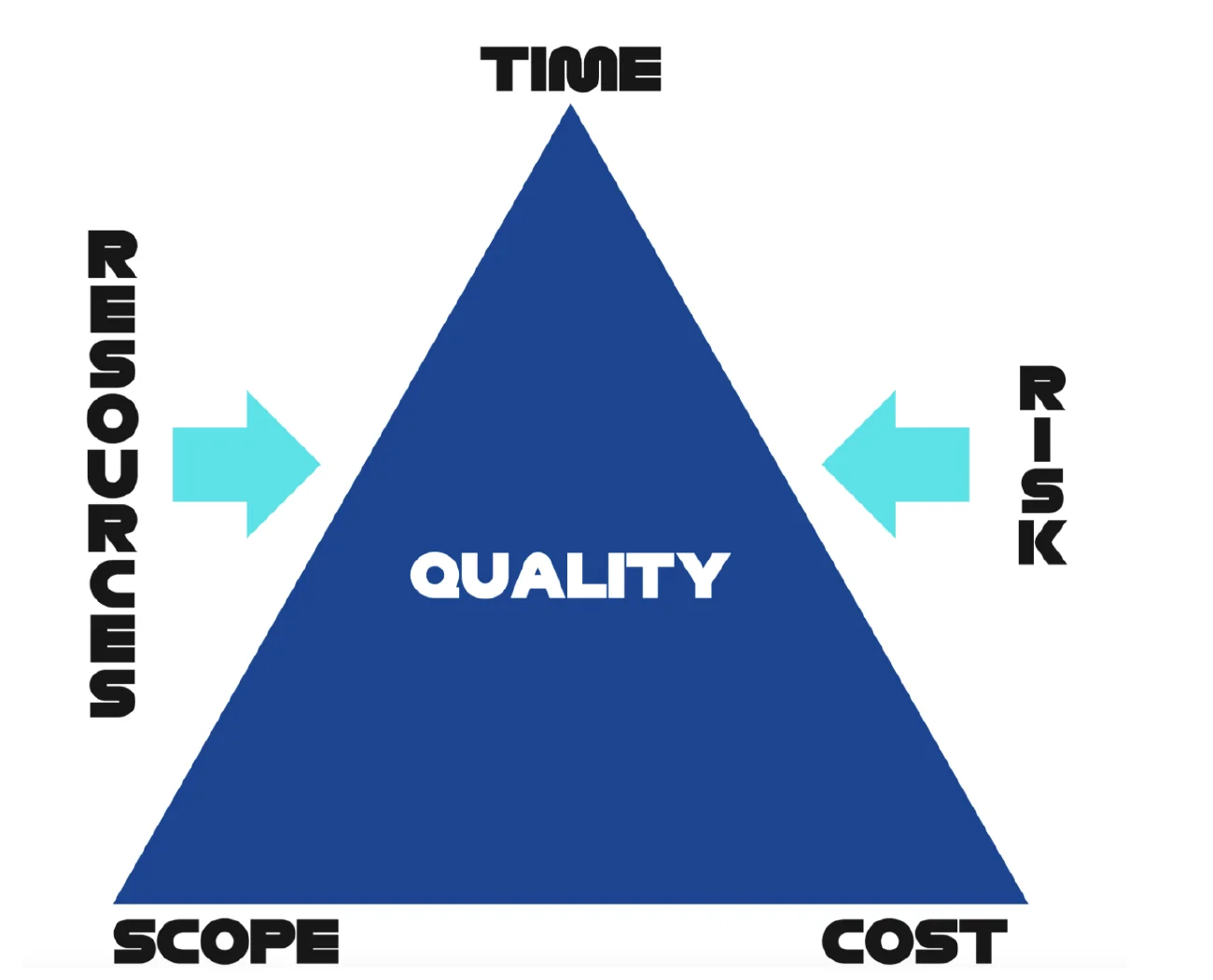
As a project manager you will want to define these parameters early in the project. Once defined, you will use these parameters as guideposts as you plan and later execute your project. You will also determine which parameter is most important and use the other two as negotiating points if necessary. For example, you might determine the most important parameter is being ready for your regional competition (time) with a car that meets the specifications (scope). If you run behind schedule, you might need more money or resources (cost) to manufacture the car correctly and make it to the competition on time.
You will notice the parameter of quality in the middle of the triple constraints and resources and risks as influencers. Quality, risks, and resources are used as references to attain your goals. You always need to keep them in mind as you plan and execute.
The Project Management Process
Any project, no matter the size or complexity, involves using specific skills, tools, and procedures to complete the project’s goals. Project management can be broken down into five processes:
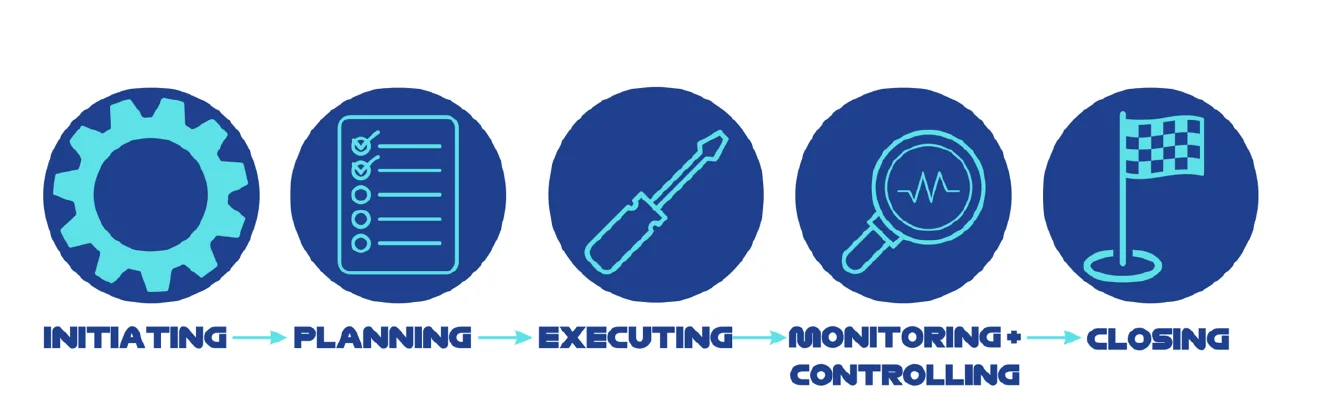
These processes help the project manager and team members define, organise, and keep track of all the work that needs to be completed for a project to be successful.
Overview
The Initiating Process is the beginning of the project. During this process, project stakeholders are identified, and a project manager is selected. Project goals and objectives are defined, and authorisation is obtained to proceed with the project.
During the Planning Process, the project plan is created. The project manager and team members define project and product scope, major deliverables, and exclusions; subdivide project deliverables and project work into smaller components (Work Break Down). This information allows the team to define the activities and tasks needed to complete the final product, service, or result. They also determine what staff and resources that are needed and establish the timeline and available budget for the project. The planning process is very important to the overall success of the project. Without careful planning, a project manager and project team may find it very difficult to achieve project success.
Executing is the process of working through the project plan. The executing process involves performing the activities outlined during the planning process.
Monitoring and Controlling occurs continuously throughout the entire project. Monitoring and controlling involves ensuring that all the tasks in the project plan are completed to produce the deliverables and final product of the project, as per the definition of the scope, on time and within budget, as well as addressing any changes necessary to successfully achieve the project goals.
In the Closing Process, project goals are delivered. Final administrative work is completed, and lessons learned are captured to improve future projects. The closing process involves taking the time to celebrate the team’s successes along the way toward completion of the project.
Each of these processes will be addressed in more detail below:
Initiating Process
The initiating process group has three goals:
- Define the project
- Identify stakeholders
- Authorise the project by developing a project charter
Defining the project
During this process you will define the goals and identify the deliverables of your STEM Racing competition entry or as we will now call it your STEM Racing Project. You will need to answer the basic project questions of Why, Who, What, When, Where and How:
WHY is the project being initiated? What is the reason for the project?
WHO is this work being done for? Identify the people participating in or affected by the project’s outcome both positively and negatively.
WHAT are we going to deliver? What work do we need to complete? What resources and funds do we need to produce these deliverables?
WHEN will we produce these deliverables? When will the project sponsor approve and accept the final project deliverables?
WHERE will the deliverables be used?
HOW are we going to achieve the project’s goal and objectives? How will success be measured?
Identify the stakeholder
Stakeholders are the people or organisations involved in, impacted by, or able to influence your project. Start with a stakeholder register, then decide how you will engage each person (for example: how often, what they care about, and what you need from them).
| Name | Role in project | Organisation | Contact | Engagement |
|---|---|---|---|---|
| Ms. Wang | Teacher | My School | smith@school.com | High: weekly; in-person; approve dates/ access |
| A Singh | Sponsor | Sponsor Inc | rharvey@sponsor.eu | Medium: monthly; email; updates & support |
| A Denford | Comp CEO | STEM Racing | info@f1is.com | Low: as needed for rules; website/ email; comply & submit |
| S Ali | Team member | My Team | millar@team.com | High: weekly; team mtgs; deliver tasks fast |
Authorise the project
A project charter is a document authorising the start of a project and is used to further clarify and refine the project. It will describe the outcomes and expectations for the project and identify the measure of performance, milestones, assumptions, constraints, and identify risks and resources.
The Why, Who, What, When, Where and How questions are used to create the project charter.
The project description outlines your goals. Goals should be specific, measurable, and observable. Goals can guide a project from start to finish. The clearer you are in defining your goals, the easier it will be to stay on track.
The project manager should be named, and a list created of the team members that will be involved in the project.
The project reason/justification outlines the reason for doing this project. The why question could be ‘we want to become World Champions’.
A milestone is an estimated time when a major deliverable will be completed. Consider when high-level progress will be made throughout the project. For example, when your car will need to be completed.
The acceptance criteria documents and signed off by the customer the approval of the final deliverable or product, indicating it meets the product or deliverable definition as a principal output of deliverables verification developed as a control quality process.
Assumptions are factors about the project that you consider true without getting proof. Identifying assumptions helps a team clarify assumptions that not all team members share. An assumption could be that your school will excuse you from class to attend a final event.
A constraint is any factor that provides a limit on the ways that a project goal can be accomplished. This may include limitations in finance, scheduling, people, or others. For example, a sponsor not paying would limit finance or the new release of the technical regulations has increased the minimum weight of the car.
Risk includes any unexpected situations that might arise that may hamper your project. Consider potential risks at the beginning and throughout a project so that you can manage them appropriately and create a plan of response. While you cannot predict all situations, the more prepared you are, the more successful your project will likely be. An example of a risk could be an issue with your 3D printer preventing you from printing your car front wing. The response plan would be to have a list of contacts who have a 3D printer and would be willing to let you use it.
Resources may include money, time, people, expertise, equipment, machinery, or a workplace. Consider all resources that would be needed for the project and their estimated cost.
By taking the time in the beginning to define the project and obtaining authorisation, teams can set themselves up for success. Once the project charter has been approved the project is authorised and can commence.
Deliverables
These are the products, services, or results of a project or phase. In STEM Racing this will be your cars, portfolio work, pit display etc. Deliverables are written as a statement of something accomplished or produced and you should track their progress throughout the project.
Milestones
Milestones will always have at least one deliverable and will include the due date. This serves as a marker for how far along you are in the project.
The Why, Who, What, When, Where and How are not yes/no questions. Instead, they are all open-ended questions. Asking open-ended questions helps get a fuller sense of what the project includes.
For example:
If your team asked, “Do we know who the project stakeholders are?” You might answer “Yes,” but it is possible that each team member has different people in mind.
Asking an open-ended question like, “Who are the project stakeholders?” provides the opportunity for all ideas.
| Project charter | Prompt |
|---|---|
| Project | STEM Racing |
| Team name | Evolution |
| Date | September 15 |
| Project manager | The person responsible for ensuring that each of the project’s goals and objectives are completed. |
| Team member | The people who work on a project and contribute to its success. |
| Project description | Describe the project. What is the goal of your project? |
| Project role/justification | Why are you doing this project? |
| Major milestones | What are the big points of progress? What are the deliverables? When are they due? |
| Acceptance criteria | How will the final product be evaluated? |
| Assumptions | What do you believe to be true about this project? |
| Constraints | What factors will limit how the project gets done? |
| Risk | What things could cause issues during the project? |
| Resources | What resources are needed? What will it cost? |
| Project Start date | XX/XX/XXXX |
| End Date | XX/XX/XXXX |
| Project Manager | Signature Date XX/XX/XXXX |
| Approved by | Signature Date XX/XX/XXXX |
Planning Process
The planning process includes the following actions:
- Writing a scope statement
- Developing the WBS (Work Breakdown Structure)
- Building a project schedule
- Planning for acquiring resources
- Creating a budget
- Assigning roles and responsibilities
- Planning how and when to communicate
- Planning for risk
- Planning how to monitor and control the project
Writing a scope statement
The scope statement builds upon the description created in the project charter in the initiating process. It sets the goals for what will be accomplished in your project. Aim to make your goal as specific as possible and measurable so you can determine if your goals are achieved.
A project scope statement describes the work that will be done and what will not be done to create the project’s unique outcome.
For example, you know you will need to prepare a verbal presentation, engineering portfolio and build a pit display so these items must appear in the scope statement. You also know that STEM Racing is a team competition so no individual work needs to be submitted and individual work would not appear in the scope statement. You should read the competition regulation carefully and list all the deliverables you are going to be expected to deliver. These are your guidelines and standards.
Developing the WBS / Planning for quality
Work Break Down is one of the most important documents. It is developed in the planning phase. It is defined in the PMBOK as a hierarchical decomposition of the total scope of work to create the project deliverables. The WBS is the foundation to define the activities to develop the schedule. It allows the creation of the budget, estimating the activities cost, the work package's main components, and the deliverables. It permits the definition and link of the resources with the activities, identification of risk for the project and requirements and necessities of the people to protect them from harmful activities during the execution.
The WBS partnering with the project scope statement forms the scope baseline. This baseline is the fundamental part of scope validation to obtain the acceptance deliverable document signed by the client.
The WBS is developed using only noun words, and every branch goes from the general to the description; for example, the car body is at the general level or top to the level, design of the car body. The level is called the work package; it represents all the activities involved in designing and calculating the car body.
A technique you can use to verify that the quality standards have been met is called acceptance criteria. You can define acceptance criteria for the entire project or specific deliverables. Since acceptance criteria identified are designed to effectively assess your tasks, they should be qualitatively or quantitatively specific. Stating to accept a car race within 1 second only does not help much. The below example demonstrates the quality acceptance criteria that could be implemented for your car development.
Sample: Quality acceptance criteria
| Quality Acceptance Criteria | Testing and Assessment | When? | Person Responsible | Review, Acceptance and Sign Off |
|---|---|---|---|---|
| Project Management Portfolio is of High Quality | Review with Scorecard Criteria and Marketing/ Branding Team | 4 Weeks before due Date | Project Manager | Team Principal/ Project Manager |
| No component breakages. | Visual signs of cracking checks. | At end of first and second round of testing | Manufacturing Engineer | Team Principal |
Planning when and how to monitor and control
Each part of the planning process builds on the others. You may find that you need to revisit and revise parts of your project along the way. This process of review and revision is part of monitoring and controlling your project. Monitoring and controlling will be easier to conduct with ongoing check-ins.
Take a moment to plan how frequently you will schedule check-ins with your team and project sponsor and how you will document the progress you are making. You may decide to check in hourly, daily, or weekly.
Building a project schedule - per each deliverable of the WBS and the project
A project schedule needs to be created, identifying all the activities that part of the work packages in the WBS to be completed including their start and due dates. The following steps should be undertaken:
Determine the major categories of work:
These categories can be established in several ways.
- By PHASES: What should be accomplished pre competition, during competition, etc?
- By MAJOR PIECES OF WORK: what should be accomplished for the design of the car, the manufacture of the car, creation of the enterprise portfolio, etc.
- By MILESTONE: Milestones are the critical points in a project's timeline that can be monitored to determine if the project is on schedule. They show completion of major pieces of the project.
Define tasks:
What tasks need to be accomplished to meet each milestone? Tasks are activities that are the “to-do” list. Breaking out the categories and tasks in this way is called a Work Breakdown Structure (WBS). Make sure that the degree of decomposition of components is appropriate.
Sample of a Work Breakdown Structure
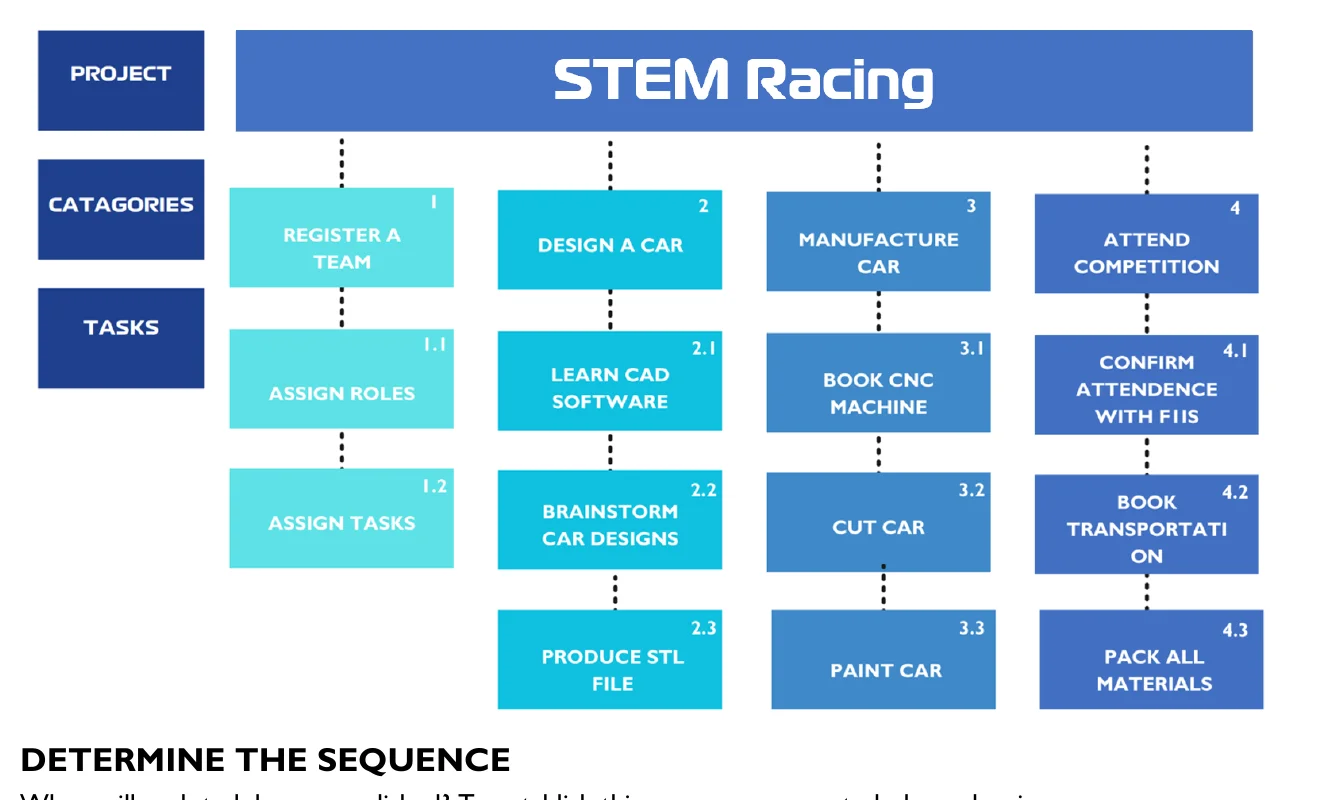
| Category | Tasks |
|---|---|
| 1 Register a team | 1.1 Assign roles 1.2 Assign tasks |
| 2 Design a car | 2.1 Learn CAD software 2.2 Brainstorm car designs 2.3 Produce STL file |
| 3 Manufacture car | 3.1 Book CNC machine 3.2 Cut car 3.3 Paint car |
| 4 Attend competition | 4.1 Confirm attendence with F1IS 4.2 Book transportation 4.3 Pack all materials |
Determine the sequence
When will each task be accomplished? To establish this sequence, assess task dependencies.
A dependent task requires completion of another task before it can begin. For example, designing your car in CAD must be done before manufacturing. For dependent tasks, be especially careful with the timeframe of the task before it to ensure your project remains on track.
An independent task can be completed at any time and is not related to the completion of another task.
Estimate time
How long will each task take? Make your best estimate based on experience or team discussions. Underestimating time is a common error. Including extra time in the schedule ensures you have the needed time to complete your project on time.
As you will be attending an event final you have a hard deadline that cannot be moved. Running out of time could mean not finishing your car or other judged work.
Build the schedule
With the above information, you can now build the schedule. The critical path is like the main route through a project, showing the longest path and the quickest way to finish. If anything slows down on this path, it will make the whole project take longer.
A Gantt chart a bar chart that shows a schedule. On the chart, activities are listed on the vertical axis, dates are on the horizontal axis and the time it takes to do each activity is shown as horizontal bars.
Various tools, such as tables in Word, charts in Excel, or project management software like Asana, JIRA, Microsoft Project, Miro, Monday, Smartsheet, Trello, or projectmanager.com, can be used to create your schedule. Check with your school to determine the accessible tools.
Sample schedule
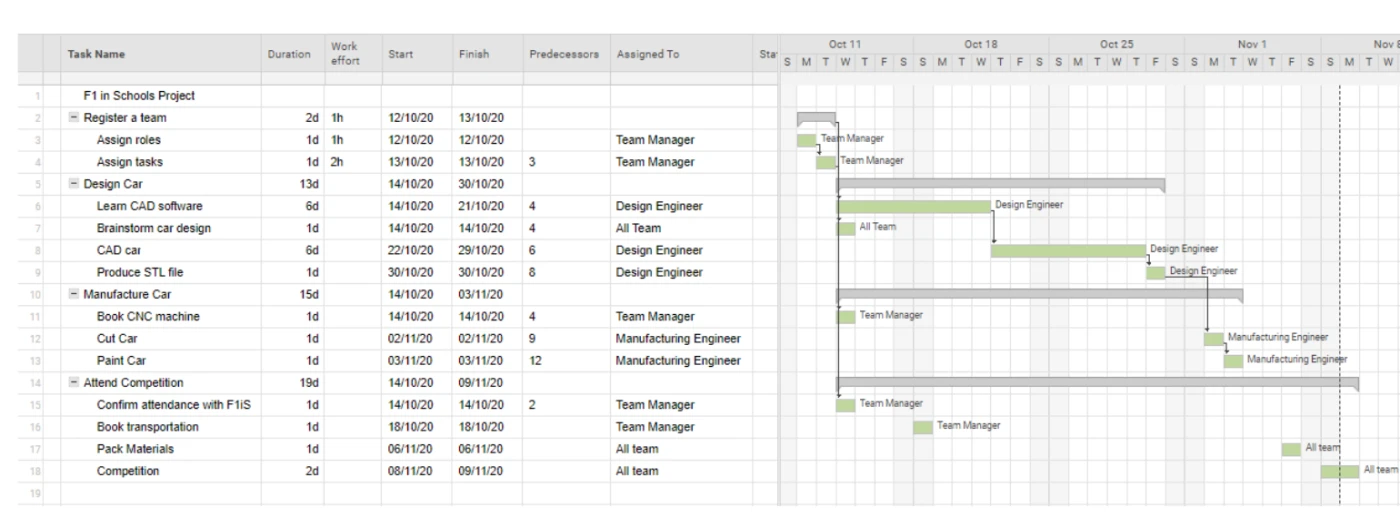
| Task Name | Duration | Work effort | Start | Finish | Predecessors | Assigned To |
|---|---|---|---|---|---|---|
| F1 in Schools Project | ||||||
| Register a team | 2d | 1h | 12/10/20 | 13/10/20 | ||
| Assign roles | 1d | 1h | 12/10/20 | 12/10/20 | Team Manager | |
| Assign tasks | 1d | 2h | 13/10/20 | 13/10/20 | 3 | Team Manager |
| Design Car | 13d | 14/10/20 | 30/10/20 | |||
| Learn CAD software | 6d | 14/10/20 | 21/10/20 | 4 | Design Engineer | |
| Brainstorm car design | 1d | 14/10/20 | 14/10/20 | 4 | All Team | |
| CAD car | 6d | 22/10/20 | 29/10/20 | 6 | Design Engineer | |
| Produce STL file | 1d | 30/10/20 | 30/10/20 | 8 | Design Engineer | |
| Manufacture Car | 15d | 14/10/20 | 03/11/20 | |||
| Book CNC machine | 1d | 14/10/20 | 14/10/20 | 4 | Team Manager | |
| Cut Car | 1d | 02/11/20 | 02/11/20 | 9 | Manufacturing Engineer | |
| Paint Car | 1d | 03/11/20 | 03/11/20 | 12 | Manufacturing Engineer | |
| Attend Competition | 19d | 14/10/20 | 09/11/20 | |||
| Confirm attendance with F1iS | 1d | 14/10/20 | 14/10/20 | 2 | Team Manager | |
| Book transportation | 1d | 18/10/20 | 18/10/20 | Team Manager | ||
| Pack Materials | 1d | 06/11/20 | 06/11/20 | All team | ||
| Competition | 2d | 08/11/20 | 09/11/20 | All team |
Planning for acquiring resources
Resource planning considers all the elements needed to complete the project, such as people, money, equipment, or space. Managing resources are essential to enhance project's overall efficiency and profitability.
In the planning process, determine where and how you will acquire each resource, when it is needed, and for how long.
Resource Management: Project resources are acquired, allocated, monitored, and controlled.
Sample resource planning
| Resource Needed | When will you need it? | How you will acquire it |
|---|---|---|
| Model block | November 15 | Place order with Denford LTD |
| Denford CNC router | November 24 (1day) | Request access via school lab technician |
| School Minibus | January 20 (2 days) | Book Minibus with School administration office |
Creating a budget
A budget is a financial plan for income and expenditure over a defined period. The best technique to create a budget is using the bottom-to-top technique in the WBS to estimate the cost of every work package until the top, the deliverable. The WBS will allow us to attach resources, equipment, and materials to complete every work package and its corresponding deliverable.
You will need to:
- Identify what items will cost you money and how much they will cost. It is normal for costs to initially be estimated and your budget should include the actual costs so you can identify any over or under spend.
- Identify where you plan to acquire the money, e.g. A fundraising event, sponsor pitch or a donation.
- Agree who will be responsible for the budget and keep a record of spending and approve any purchases.
There can be many different costs associated with an entry to STEM Racing, some of which may not be immediately obvious or expected. For example, they may be associated with risks you have identified or unexpected changes that you need to make as you develop your car. There may also be a scenario where items cost more than you expected, and you need to ensure your budget can accommodate all these. In finance this is called the budget contingency. You can decide how much contingency you need by assessing how likely each of the scenarios presented above are likely to happen.
Cost–benefit decisions: When you choose between options (e.g., materials, testing time, manufacturing method, travel choices), write a short justification that compares cost, expected benefit, and impact on schedule/quality. This is evidence of value-focused decision making.
Sample budget
| Resource | Budget cost | Actual cost | Difference |
|---|---|---|---|
| Equipment | |||
| Travel | |||
| Materials | |||
| Contingency |
Planning when, what and how you communicate
Team members and stakeholders need information on the project's development and potential changes to complete the work.
Planning communication involves understanding who needs to communicate, how often, and what information is relevant to each stakeholder.
Assigning roles and responsibilities
Assess the strengths, skills, and abilities of each team member to assign responsibilities effectively. Use a Responsibility Assignment Matrix (RAM). A legend or key is usually applied to the RAM, the one most used is known as RACI (Responsible - Accountable - Consulted – Informed), to assign team members to tasks.
Sample responsibility assignment matrix using RACI
| Task | Team Principal / Project Manager | Design Engineer | Manufacturing Engineer | Graphic Designer |
|---|---|---|---|---|
| Design Car using Autodesk | Consulted | Accountable/ Responsible | Consulted | Informed |
| Design Team Logo | Consulted | Consulted | Informed | Accountable/ Responsible |
| Create Budget | Accountable | Consulted | Consulted | Informed |
| Book CNC Time | Informed | Consulted | Accountable/ Responsible | - |
Legend / Key:
- Responsible for doing the work
- Accountable for making sure the work gets done
- Consulted to provide critical input to the work
- Informed of the work being done or completed
A STEM Racing team will be very structured, the rules and regulation documents highlight the roles that a team should have. This does not limit you assigning other roles to team members.
It is important to ensure that each activity and task identified in the project schedule is allocated to a team member.
Communications
It is very important to have an internal project team communication plan. You should agree how you plan to communicate, how often, where, and when. Look at the various communication tools that are available to you in case you cannot always meet in person and weigh up the advantages of different platforms for different tasks.
Sample communication matrix
| Who to contact | What to communicate | Communication method | When |
|---|---|---|---|
| Teacher | Milestones met | Face to Face | Milestone completion |
| STEM Racing HQ | Competition registration | Email / on-line forms | Start of year and when information is requested |
| Sponsors | Competition progress update | Newsletter Email | Monthly |
| Team members | Team update | Microsoft Teams | Daily @ lunchtime |
It is very important to have an internal project team communication plan. You should agree how you plan to communicate, how often, where, and when. Look at the various communication tools that are available to you in case you cannot always meet in person and weigh up the advantages of different platforms for different tasks.
Planning and monitoring for risk.
The objective is to identify two kinds of risks. The first might impact the project's triple constraints (scope, schedule, and cost); the second type of risk might affect the safety of people and the environment.
- Risk Identification
- Risk Analysis and Assessment
- Risk Response
- Continue to Monitor Risks
The efficient form to identify risks is using the WBS.
WBS outlines the systematic approach to managing risks, from identification to response and continued monitoring, as well as the classification and assessment of risks based on their impact and probability. The main idea is to evaluate each component (work packages from the bottom to the top of the WBS).
Risks can be negative or positive.
Risk Responses for threats that may have a negative impact include Accept, Avoid, Escalate, Mitigate or Transfer.
Risk Responses for Opportunities that may have a positive impact include Accept, Enhance, Escalate, Exploit or Share.
Risks could affect various areas of the project, including:
- Resources: Ability to acquire people, equipment, funding, or other resources to complete project. All of these apply to STEM Racing.
- Timing: Will deliverables or the entire project be completed on schedule? This is critical for STEM Racing as you have a hard deadline of attending a STEM Racing event.
- Scope: Completing and delivering all the items named in the original scope. You may choose to change the class of the competition you have entered.
- Quality: How well each deliverable meets the goals set in the acceptance criteria. Has your car been manufactured as expected?
Qualifying risks
All identified risks are important and valuables to successfully complete the project. However, not all risks are having the same level of importance or urgency. Thus, classified risks due to their impact over the triple constrain (Scope, Time, cost) is particularly important.
Example of risk assessment matrix
| What is the Risk | Threat or Opportunity? | Risk Impact L = Low M = Medium H = High | Risk Probability | Risk Score | Area of Impact R = Resource T = Timing S = Scope Q = Quality | Risk Response |
|---|---|---|---|---|---|---|
| Additional Testing Resources made available to the Team | Opportunity | L | M | M | R - Additional Resources made available | Q: Shorter cycles to improve our car Enhance: - Book additional Testing Time - Update car manufacturing schedule |
| Car front wing damaged during testing | Threat | M | L | M | R – New part will need to be manufactured T – We may not have enough time to manufacture a new wing before the finals | Mitigate -Manufacture a spare wing -Ensure testing takes place well before the finals |
The Executing Process
Executing is the process of working through the project plan. This involves putting your project plan into action. The project plan serves as a guide to help ensure that the deliverables — the intended goals of the project — will be completed properly, on time, and within the budget.
As work is being executed, you should strive to:
- Use your budget and resources as planned.
- Manage the risks you identified.
- Stay focused only on the work you described in your project’s scope.
- Meet your milestones.
- Document your progress in an organised way.
- Communicate your project’s progress regularly and effectively to your stakeholders.
- Update any component of the initial project management plan if needed
By checking on your progress, evaluating whether project goals are being achieved in the best possible way and being prepared to adjust their path, if necessary, you are engaged in the monitoring/controlling process.
The Monitoring and Controlling Process
Monitoring/controlling is a continuous process throughout the project life cycle. Project managers and team members need to establish a cycle to evaluate the progress of the project and report back to stakeholders about project developments.
Validating and controlling the scope
This is a key component of the monitoring/controlling process group.
Keep the following in mind:
- Ensures that all the tasks necessary to achieve the project goals are completed.
- Identify if any activities need to be added to the project.
- Prevent work on the project from going beyond the scope.
- Determine what to do if any activity is taking more time than planned.
Scope creep
This occurs when work is added to the project without appropriately adjusting the schedule and resources, and without obtaining sponsor approval.
Routinely review the Acceptance Criteria that were established in the project to make sure that the products of a project will satisfy project stakeholders’ needs and meet their standards.
Avoiding scope creep should start early in the project, ideally during the initiating process when you established a goal and set the boundaries for the project’s work and scope. During the planning process you established what would not be included or would be “out of scope” for the project. If you establish early what is and what is not a part of the project’s scope you can rely on and monitor those plans to help you avoid scope creep.
Adjust for the unexpected
It is more than likely that you will encounter some surprises as the project progresses. This is OK, it is what monitoring and controlling is for. Discuss any surprises that occur as project work is being done. If a change needs to occur, review the schedule, resources, and scope to see if there are other changes that need to be made.
Status reports
A status report is an effective way to monitor and document of the progress of your project — and to communicate that progress to others. Each status report should include:
- What work has been completed
- What tasks are in progress
- What work is still planned
- What issues have developed
Status reports can help identify items that might affect the project scope, timeline, budget, or deliverables. For example, if you raise money to buy a 3D printer but this arrives 2 weeks late, this will affect your timeline and you may not have time to 3D print your wheels for the regional final.
Sample status report
Status Report
Project: STEM Racing
Team name: Evolution
Date: November 12
Project status: in good shape
Tasks accomplished:
- All sponsorship acquired.
- Car CAD design milestone achieved and car ready for cfd analysis and then manufacture.
Tasks in progress:
- CFD analysis underway.
- Manufacturing engineer is preparing resources (model blocks) and booking the Denford CNC router to cut the car.
Planned tasks
- Portfolio writing.
- Verbal presentation script writing and presentation creation.
Issues:
- One of the team members has an appointment clash on the date of the regional final. They are currently attempting to reschedule the appointment.
- Our 3D printer needs maintenance, and we are yet to confirm an engineer site visit.
Questions for discussion:
- We need to finalise our transport arrangements for attending the finals.
The Closing Process
Closing is the process of completing the project. Finishing a project is an accomplishment. It is the achievement of a lot of work. As a group, you and your team members collectively sparked an idea, planned it, executed the plan, monitored/controlled your progress, and have now reached the closing process.
In the closing process you can reflect upon the quality of the project deliverables, what you learned about managing a project, and how well you and your team worked together.
In the closing process there is still some work to be completed as follows:
- A closing presentation is created, for some projects, to present the final report to the stakeholders.
- Collect and store any project-related paperwork and documents (such as the project plan, completed schedule, etc.) in a project portfolio such as in a notebook or a computer. These documents become reference material for future projects.
- Team members need to “sign off” on the project to verify that the project is completed.
- Create a Lessons Learned document with team members by asking what went well, what could have been done better, and what should continue. You may have received feedback from the judges which should be included. You can also reflect on how your car performed on the track.
- Complete a self and peer assessment. Include whether you and your group:
- Treated each other with respect,
- Shared responsibilities,
- Communicated clearly and effectively,
- Worked in an organized fashion and
- Managed time wisely.
- Finally, celebrate all that you and your team have accomplished! Regardless of the outcome, you have dedicated time and effort, learned a lot along the way, and should be rewarded for such effort.
Example lessons learned report
Lessons Learned
Project: STEM Racing
Team name: Evolution
Date: January 15
What did we do right?
- We won the regional final and have a place at the national finals.
What could we have done better?
- We have not scored well in our verbal presentation. We all acknowledge we did not rehearse this enough.
- Our car was not as fast as we had hoped. We all acknowledge that we did not leave enough time to test our prototypes.
What should we continue to do?
- Test, test, test
- Verbal presentation script writing, this really helped
What significant issues did we encounter and how did we resolve?
- Our 3d printer really let us down
- We built a relationship with our local university to gain access to their equipment
What are our lessons learned?
- We need to use as much time as we can analysing our cad design. Our car was fast, but we wanted to win the fastest car award
- We should have had more team meetings especially as we progressed through the project milestones
Sample self & peer assessment
SELF AND PEER ASSESSMENT
PROJECT: STEM Racing
TEAM NAME: Evolution
DATE: JANUARY 15
List your team’s members, including yourself, in the space provided below. Then, rate every person on each behaviour listed.
4 = Always
3 = Usually
2 = Sometimes
1 = Never
| Behaviours | Team Member Names (including your own) |
|---|---|
| Exhibited a positive attitude | - |
| Treated other with respect | - |
| Shared responsibilities | - |
| Did work accurately & completely | - |
| Communicated clearly & effectively | - |
| Was organized | - |
| Managed time wisely | - |
Key Terms
Initiating process
| Term | Definition |
|---|---|
| Acceptance criteria | A set of conditions that is required to be met before deliverables are accepted. |
| Assumption | A factor in the planning process that is true, real, or certain, without proof or demonstration. |
| Constraint | A limiting factor that affects the execution of a project, program, portfolio, or process. |
| Deliverables | Any unique and verifiable product, result, or capability to perform a service that is required to be produced to complete a process, phase, or project. |
| Milestone | A type of schedule that presents milestones with planned dates. |
| Project charter | A document issued by the project initiator or sponsor that formally authorises the existence of a project and provides the manager with the authority to apply organisational resources to project activities. |
| Project scope | The work performed to deliver a product, service, or result with the specified features and functions. |
| Resource | A team member or any physical item needed to complete the project. |
| Risk | An uncertain event or condition that, if it occurs, has a positive or negative effect on one or more of the project objectives. |
| Stakeholder register | A project document including the identification, assessment, and classifications of project stakeholders. |
| Negative interest | A stakeholder with negative interest is typically one who is affected by the outcomes of a project. They either do not want that outcome to happen or will be negatively impacted by that outcome. |
Planning process
| Term | Definition |
|---|---|
| Milestone | A significant point or event in a project, program, or portfolio. |
| Planning process | Those processes required to establish the scope of the project, refine the objectives, and define the course of action required to attain the objectives that the project was undertaken to achieve. |
| Project schedule | An output of a schedule model that presents linked activities with planned dates, durations, milestones, and resources. |
| Scope | The sum of the products, services, and results to be provided as a project. |
| Work Breakdown Structure (WBS) | A hierarchical decomposition of the total scope of work to be carried out by the project team to accomplish the project objectives and create the required deliverables. |
| Gantt Chart | A bar chart provides schedule information where activities are listed on the vertical axis, dates are shown on the horizontal axis, and activity durations are shown as horizontal bars placed according to start and finish dates. |
| Critical Path | The sequence of activities that represents the longest path through a project, which determines the shortest possible duration. |
| Responsibility Assignment Matrix (RAM) | This matrix is a grid that shows the project resources assigned to each work package. A RACI chart is a common way of showing stakeholders who are responsible, accountable, consulted, or informed and are associated with project activities, decisions, and deliverables. |
| Budget | A financial plan for income and expenditure over a defined period. |
Executing / Monitoring / Controlling
| Term | Definition |
|---|---|
| Communications management | A component of the project, program, or portfolio management plan that describes how, when, and by whom information about the project will be administered and disseminated |
| Executing process | Those processes performed to complete the work defined in the project management plan to satisfy the project requirements. |
| Monitoring/controlling | The processes required to track, review, and regulate the progress and performance of the project; identify any areas in which changes to the plan are required; and initiate the corresponding changes. |
| Risk | An uncertain event or condition that, if it occurs, has a positive or negative effect on one or more project objectives. |
| Scope creep | The uncontrolled expansion to product or project scope without adjustments to time, cost, and resources. |
| Status Report | A report on the current status of the project. |
Closing process
| Term | Definition |
|---|---|
| Closing process | The process(es) performed to formally complete or close a project, phase, or contract. |
| Lessons Learned | The knowledge gained during a project which shows how project events were addressed or should be addressed in the future for the purpose of improving future performance. |
Project Management Portfolio
| Project Management Assessment | Suggest Checklist |
|---|---|
| Initiation Process | Kick Off Meeting Project Charter Scope Statement Quality Acceptance Criteria |
| Project Schedule | Work Breakdown Structure (WBS) Schedule GANTT Chart |
| Budget and Resource Management | Resource Management Budget Expenditure Tracking (Baseline vs. Actual) |
| Roles and Responsibilities | Role Descriptions Team Structure RACI Chart |
| Team & Stakeholder Communications | Communication Plan (Internal and External) Communication Tools Stakeholder Register |
| Risk Management | Risk Identification, Planning, Analysis and Assessment Risk Register Impact and Probability |
| Monitoring & Controlling | Status Report Scope Creep Sign Off |
Further Reading
For more resources and information about project management, head to the resources page of the STEM Racing website:
- STEMRACING.COM
- RULES AND REGS
- PMIEF Project Management Skills for Life® (2025)
- AGILE PRACTICE GUIDE
- KICK OFF
Project Management: Agile, Predictive, and Hybrid
Managing a project is like guiding a ship. Depending on your destination and the weather, there are different ways to steer it. Let's explore three methods: Agile, Predictive, and Hybrid.
Agile: Flexible and Fast
Agile is like building a Lego castle without a fixed plan. You start, get feedback, and keep adding pieces. It's great for projects that change a lot, like making an app.
Key Points: Flexible, iterative, teamwork-focused.
Predictive: Plan It All
Predictive is like following instructions to build a model airplane. You plan everything and stick to it, perfect for projects with clear steps, like constructing a building.
Key Points: Detailed planning, steady progress, less flexibility.
Hybrid: Uncertainty or risk around Requirements
Hybrid mixes Agile and Predictive. It's like baking a cake using a recipe but adding your choice of toppings. You have a plan but can tweak it. This approach suits projects needing structure and some adaptability.
Key Points: Combines methods, flexible planning, balanced.
Conclusion: Choosing a project management method depends on your project's needs. Agile lets you adapt quickly, Predictive keeps you on a set path, and Hybrid offers a middle ground. It's like picking the best route for your ship, ensuring a successful journey!